IAN KENNEALLY - HISTORIAN, WRITER AND PRODUCER
  • Home
  • Books
    • From the Earth, A Cry
    • AIT: a history
    • The Paper Wall
    • Courage & Conflict >
      • John Barry
      • The San Patricios
      • The Irish Battalion of the Papal Army
      • Irish Soldiers of the American Civil War
      • John Philip Holland
      • The Irish who fought at the Little Bighorn
      • John Henry Patterson
      • Mutiny in the Connaught Rangers
      • Dublin's Bloody Sunday
    • The Irish Regional Press, 1892–2018
  • Research and Consultancy
    • The History Show
    • 19 Crimes
    • 1921 Expedition to Mount Everest
    • Historian in Residence: 2020, 2021 and 2022
    • The Revolution Papers
    • AIT: a history
    • Gorey: a portrait of a town and its hinterland
  • Headlines from History
  • Exhibitions
    • 1921 Expedition to Mount Everest
    • 'Shall the punishment fall on the girl alone'
  • Documentaries
  • Other Projects
    • Atlas of the Irish Revolution
    • The Irish-American Press
    • Irish Journalism before Independence
    • Independent Newspapers: A History
    • War of Independence in the Midlands
    • Periodicals and Journalism in 20th Century Ireland
    • Irish Civil War in the Midlands
  • Gallery
  • Contact

Athlone Advertiser


Part of the Advertiser group of newspaper, the Athlone edition has a weekly circulation of almost 10,000 copies each week.
I contribute a weekly column to the Athlone Advertiser - www.advertiser.ie/athlone - which discusses aspects of Irish history and the activities
of people from Athlone and its hinterland, whether at home or abroad.

Click the images to see the articles
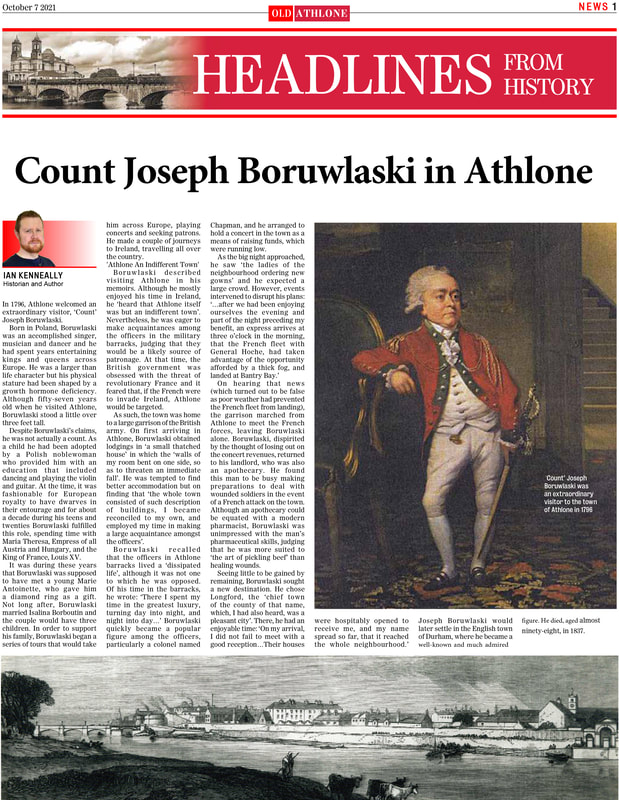

In 1796, Athlone welcomed an
extraordinary visitor, ‘Count’
Joseph Boruwlaski.
Born in Poland, Boruwlaski
was an accomplished singer,
musician and dancer and he
had spent years entertaining
kings and queens across
Europe. He was a larger than
life character but his physical
stature had been shaped by a
growth hormone deficiency.
Although fifty-seven years
old when he visited Athlone,
Boruwlaski stood a little over
three feet tall.
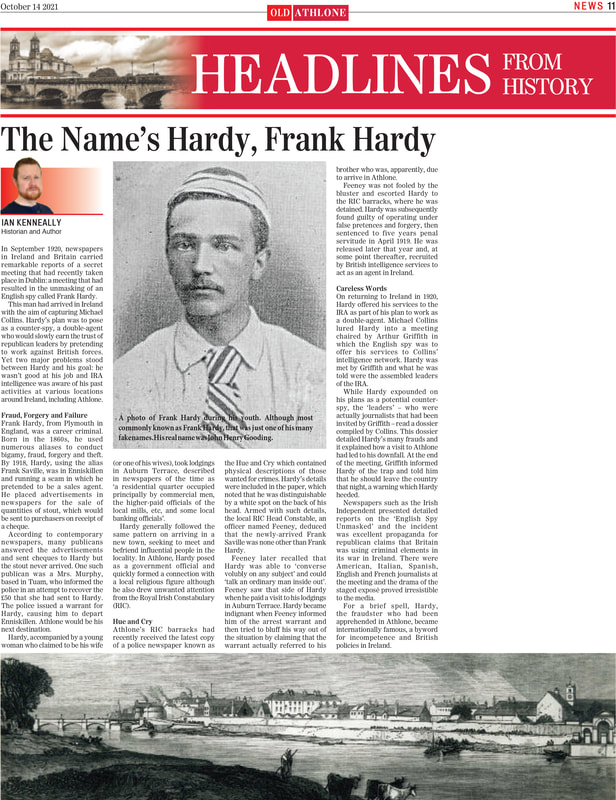
John Henry Gooding, confidence trickster and fraudster. One of his many aliases was Frank Hardy.
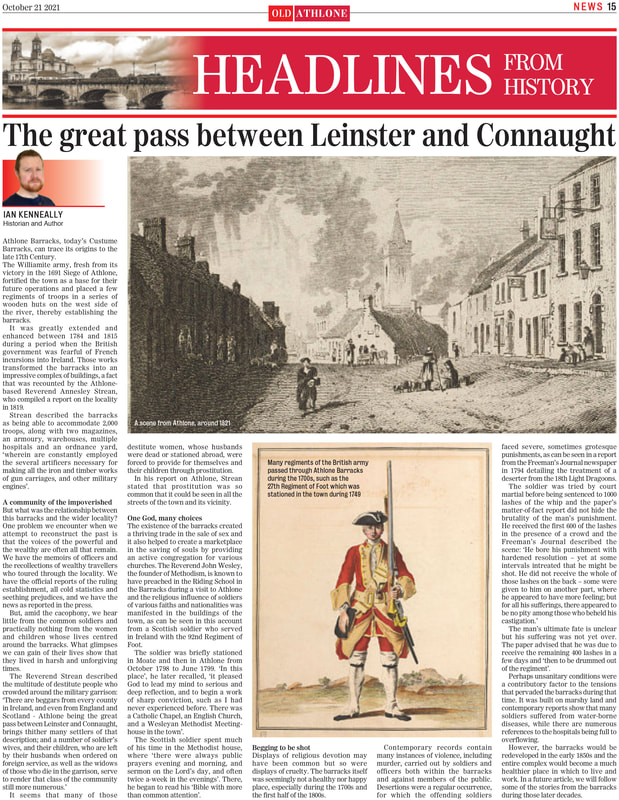
Athlone Barracks, today’s Custume
Barracks, can trace its origins to the
late 17th Century.
The Williamite army, fresh from its
victory in the 1691 Siege of Athlone,
fortified the town as a base for their
future operations and placed a few
regiments of troops in a series of
wooden huts on the west side of
the river, thereby establishing the
barracks
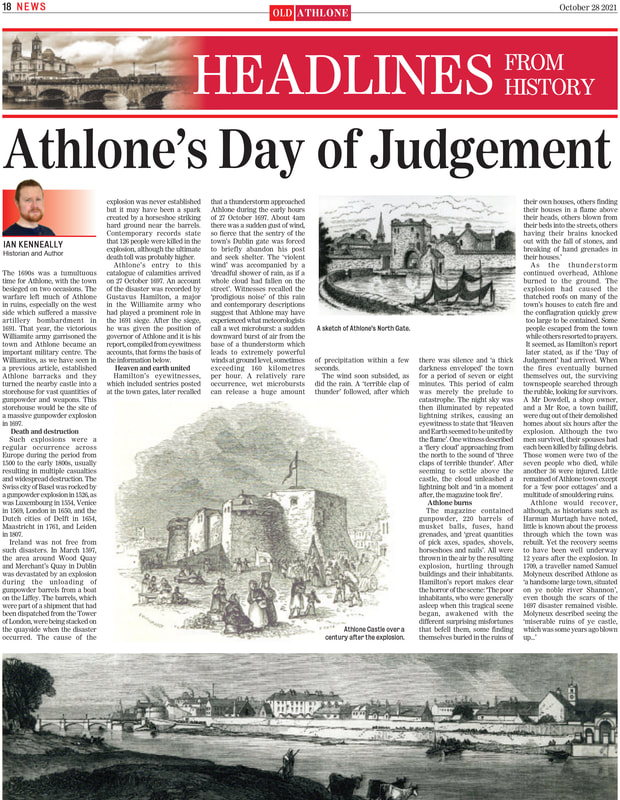
The devastation caused to Athlone Castle and the surrounding town caused by a huge explosion in October 1697.
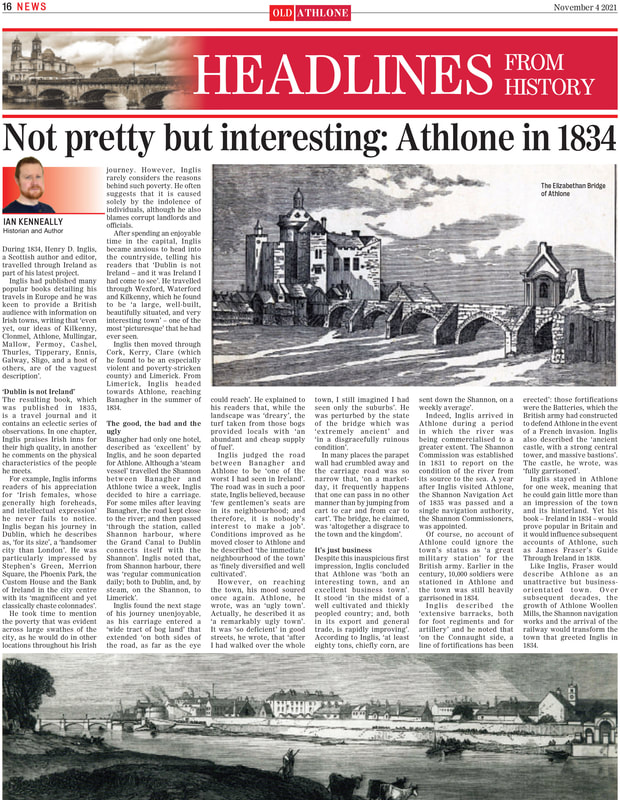
During 1834, Henry D. Inglis,
a Scottish author and editor,
travelled through Ireland as
part of his latest project.
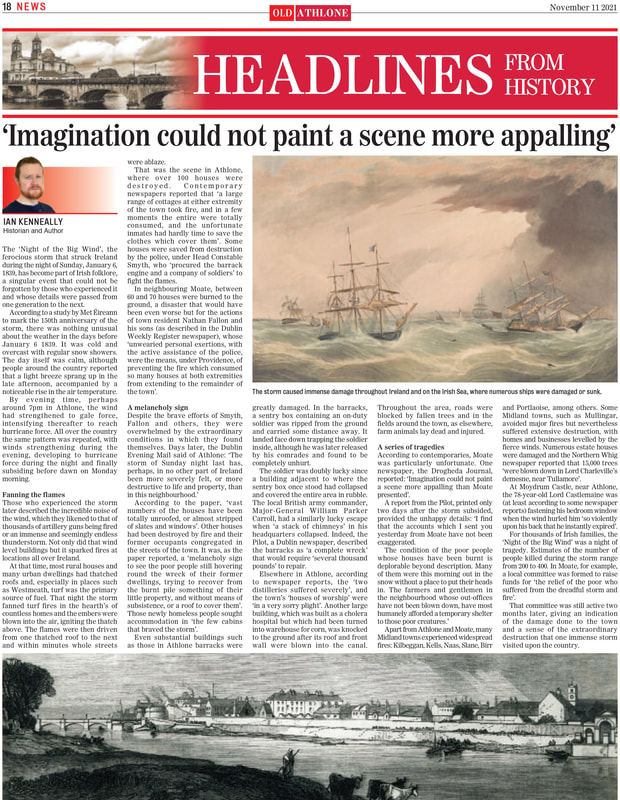
The ‘Night of the Big Wind’, the
ferocious storm that struck Ireland
during the night of Sunday, January 6,
1839, has become part of Irish folklore,
a singular event that could not be
forgotten by those who experienced it
and whose details were passed from
one generation to the next.
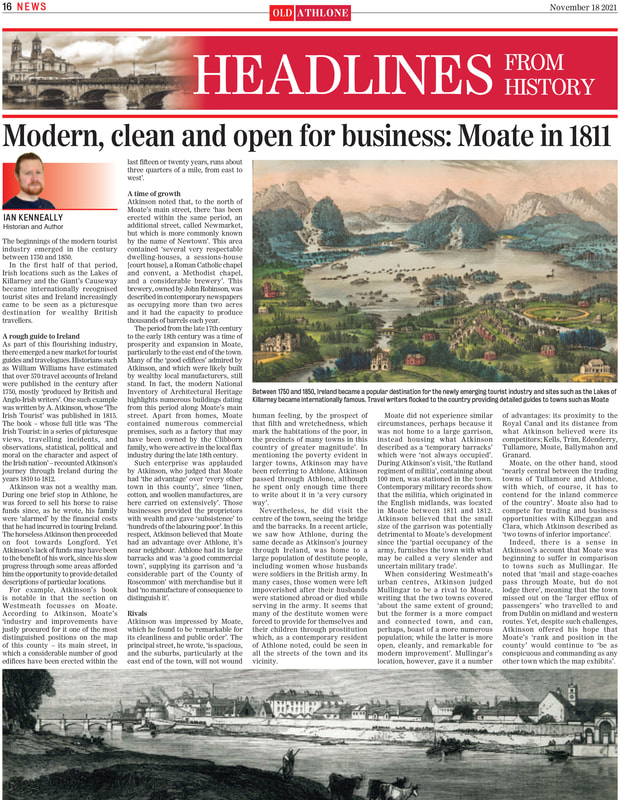
One such tourist guide was written by A. Atkinson, whose ‘The
Irish Tourist’ was published in 1815.
The book – whose full title was ‘The
Irish Tourist: in a series of picturesque
views, travelling incidents, and
observations, statistical, political and
moral on the character and aspect of
the Irish nation’ – recounted Atkinson’s
journey through Ireland during the
years 1810 to 1812.
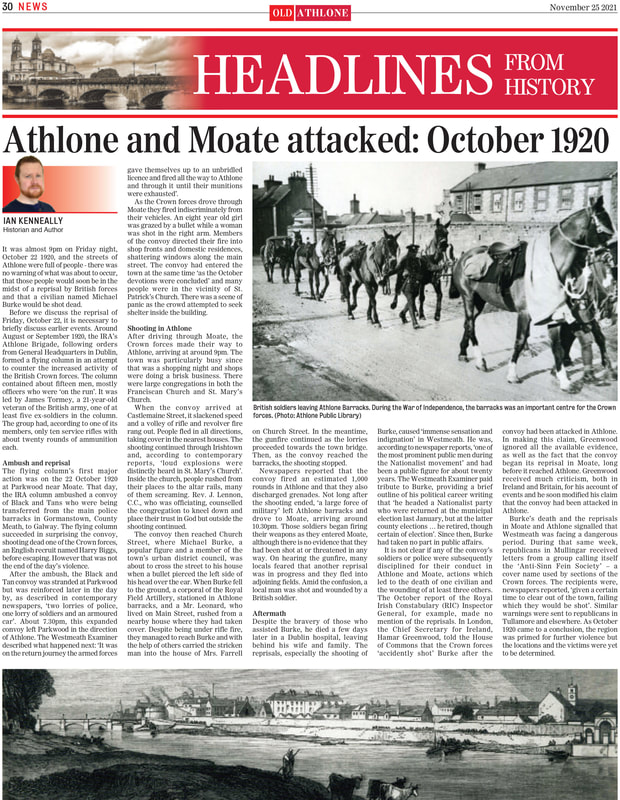
It was almost 9pm on Friday night,
October 22 1920, and the streets of
Athlone were full of people - there was
no warning of what was about to occur,
that those people would soon be in the
midst of a reprisal by British forces
and that a civilian named Michael
Burke would be shot dead.
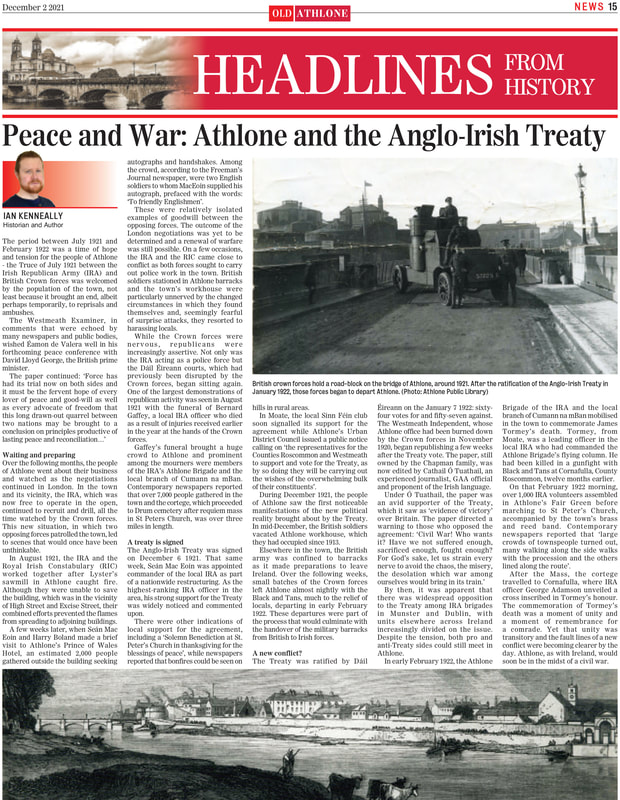
The period between July 1921 and
February 1922 was a time of hope
and tension for the people of Athlone
- the Truce of July 1921 between the
Irish Republican Army (IRA) and
British Crown forces was welcomed
by the population of the town, not
least because it brought an end, albeit
perhaps temporarily, to reprisals and
ambushes.
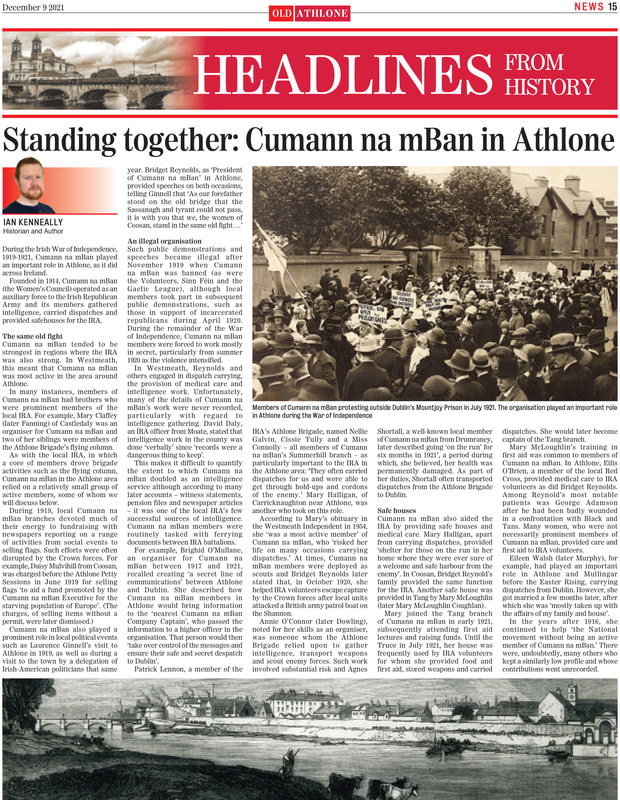
During the Irish War of Independence,
1919-1921, Cumann na mBan played
an important role in Athlone, as it did
across Ireland.
Founded in 1914, Cumann na mBan
(the Women’s Council) operated as an
auxiliary force to the Irish Republican
Army and its members gathered
intelligence, carried dispatches and
provided safehouses for the IRA.
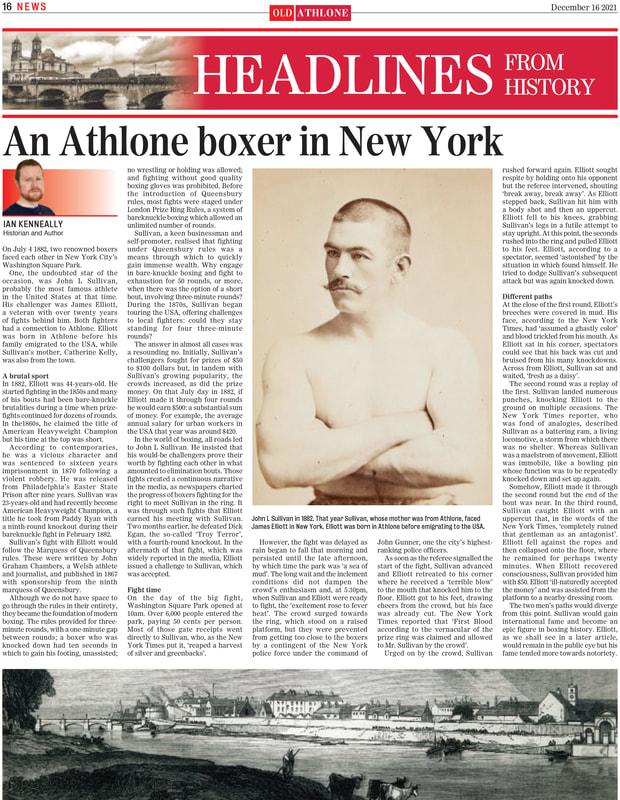
On July 4 1882, two renowned boxers
faced each other in New York City’s
Washington Square Park.
One, the undoubted star of the
occasion, was John L Sullivan,
probably the most famous athlete
in the United States at that time.
His challenger was James Elliott,
a veteran with over twenty years
of fights behind him.
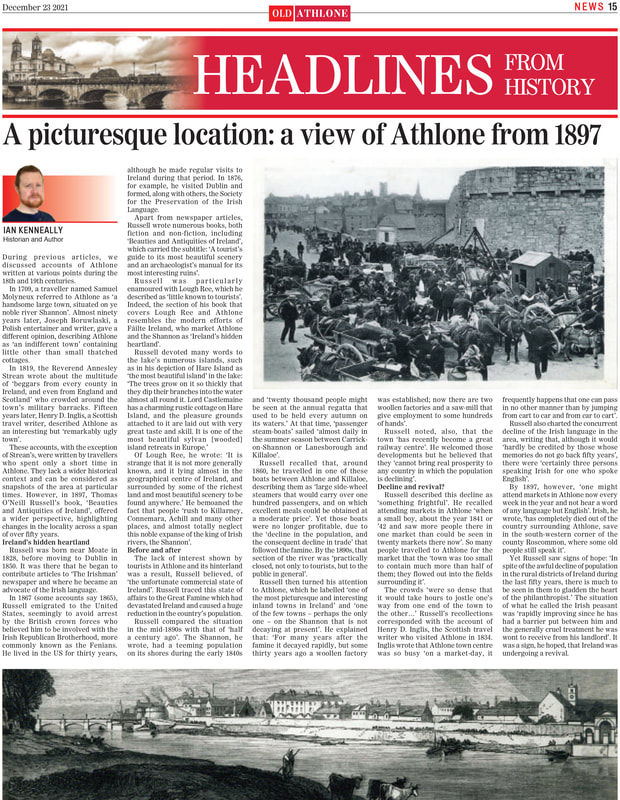
In 1897 Thomas O’Neill Russell’s book, ‘Beauties
and Antiquities of Ireland’, offered
a wider perspective, highlighting
changes in the locality across a span
of over fifty years.
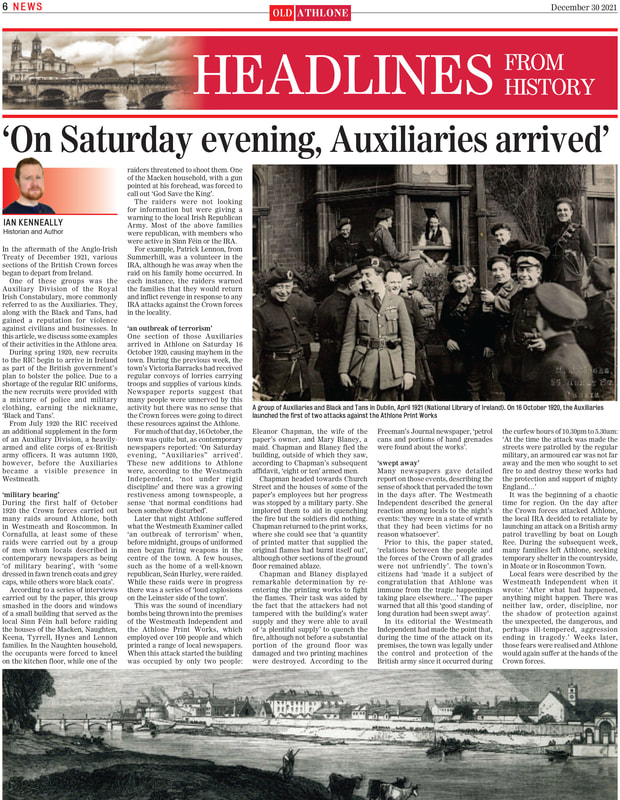
One section of those Auxiliaries
arrived in Athlone on Saturday 16
October 1920, causing mayhem in the
town. During the previous week, the
town’s Victoria Barracks had received
regular convoys of lorries carrying
troops and supplies of various kinds.
Newspaper reports suggest that
many people were unnerved by this
activity but there was no sense that
the Crown forces were going to direct
these resources against the Athlone.
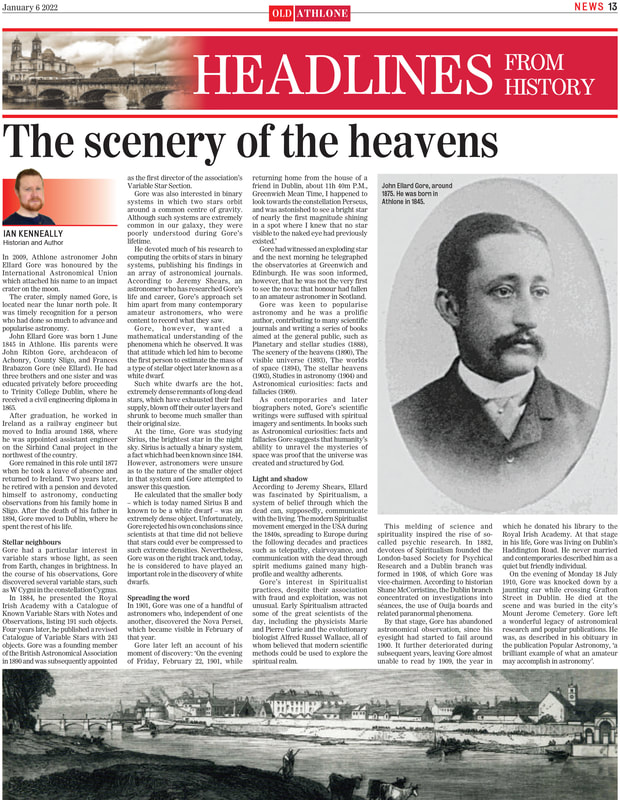
In 2009, Athlone astronomer John
Ellard Gore was honoured by the
International Astronomical Union
which attached his name to an impact
crater on the moon.
The crater, simply named Gore, is
located near the lunar north pole. It
was timely recognition for a person
who had done so much to advance and
popularise astronomy.
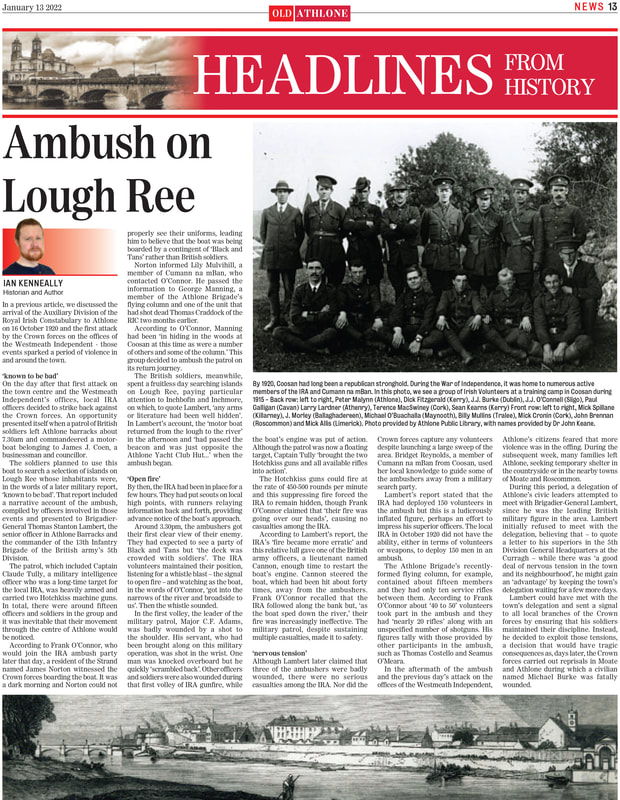
On the day after that first attack on
the town centre and the Westmeath
Independent’s offices, local IRA
officers decided to strike back against
the Crown forces. An opportunity
presented itself when a patrol of British
soldiers left Athlone barracks about
7.30am and commandeered a motor-
boat belonging to James J. Coen, a
businessman and councillor.
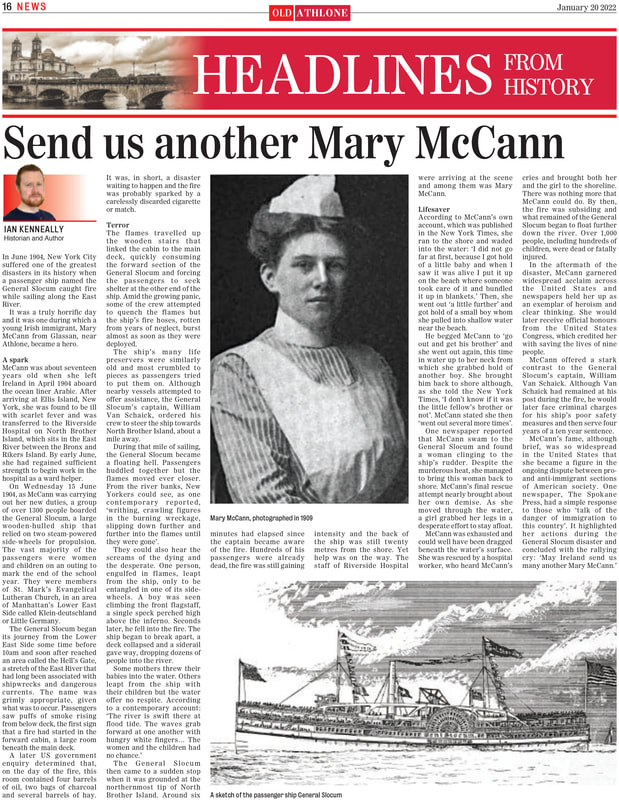
In June 1904, New York City
suffered one of the greatest
disasters in its history when
a passenger ship named the
General Slocum caught fire
while sailing along the East
River.
It was a truly horrific day
and it was one during which a
young Irish immigrant, Mary
McCann from Glassan, near Athlone, became a hero.
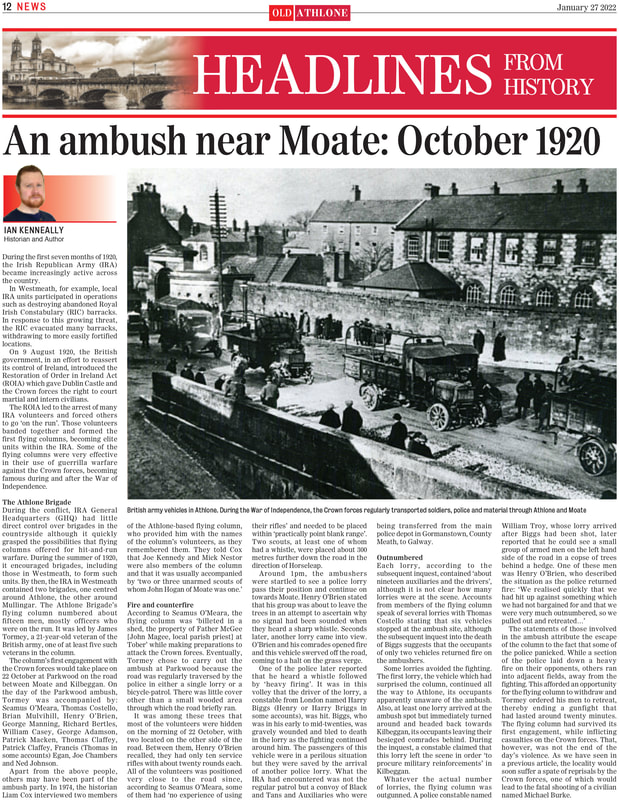
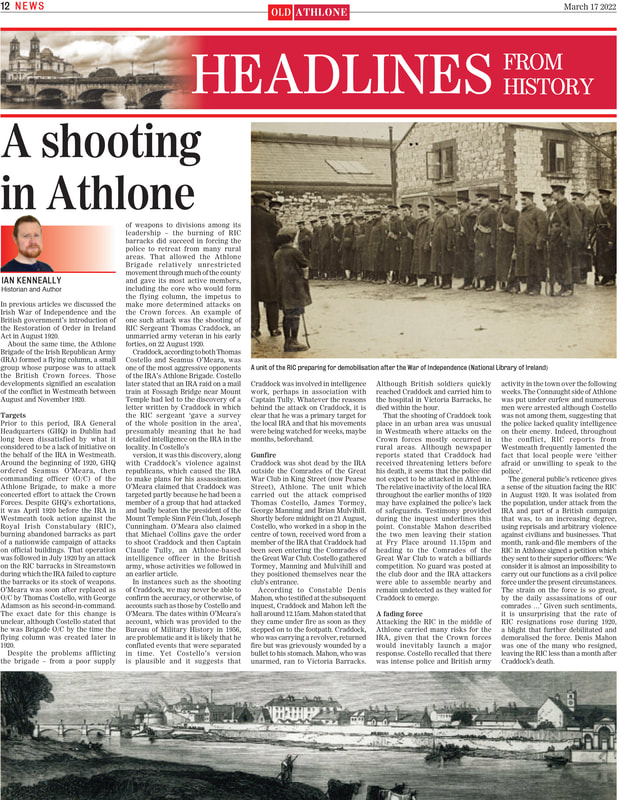
During the conflict, IRA General
Headquarters (GHQ) had little
direct control over brigades in the
countryside although it quickly
grasped the possibilities that flying
columns offered for hit-and-run
warfare. During the summer of 1920,
it encouraged brigades, including
those in Westmeath, to form such
units. By then, the IRA in Westmeath
contained two brigades, one centred
around Athlone, the other around
Mullingar. The Athlone Brigade’s
flying column numbered about
fifteen men, mostly officers who
were on the run. It was led by James
Tormey, a 21-year-old veteran of the
British army, one of at least five such
veterans in the column.
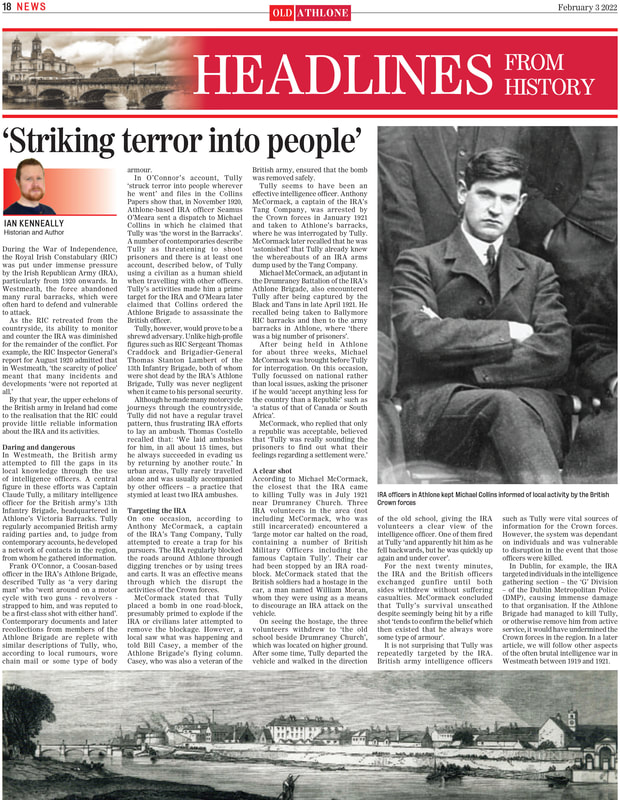
In Westmeath, the British army
attempted to fill the gaps in its
local knowledge through the use
of intelligence officers. A central
figure in these efforts was Captain
Claude Tully, a military intelligence
officer for the British army’s 13th
Infantry Brigade, headquartered in
Athlone’s Victoria Barracks. Tully
regularly accompanied British army
raiding parties and, to judge from
contemporary accounts, he developed
a network of contacts in the region,
from whom he gathered information.
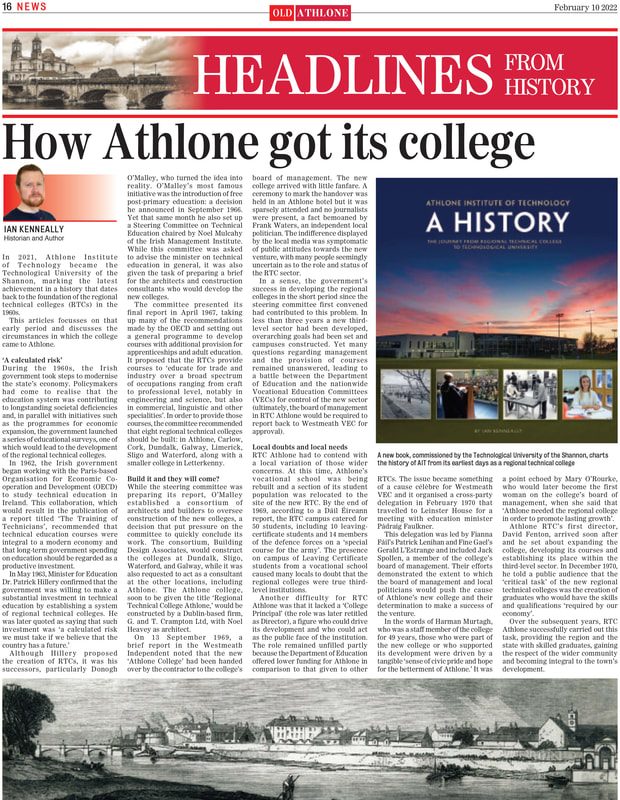
During the 1960s, the Irish government took steps to modernise
the state’s economy. Policymakers
had come to realise that the
education system was contributing
to longstanding societal deficiencies
and, in parallel with initiatives such
as the programmes for economic
expansion, the government launched
a series of educational surveys, one of
which would lead to the development
of the regional technical colleges.
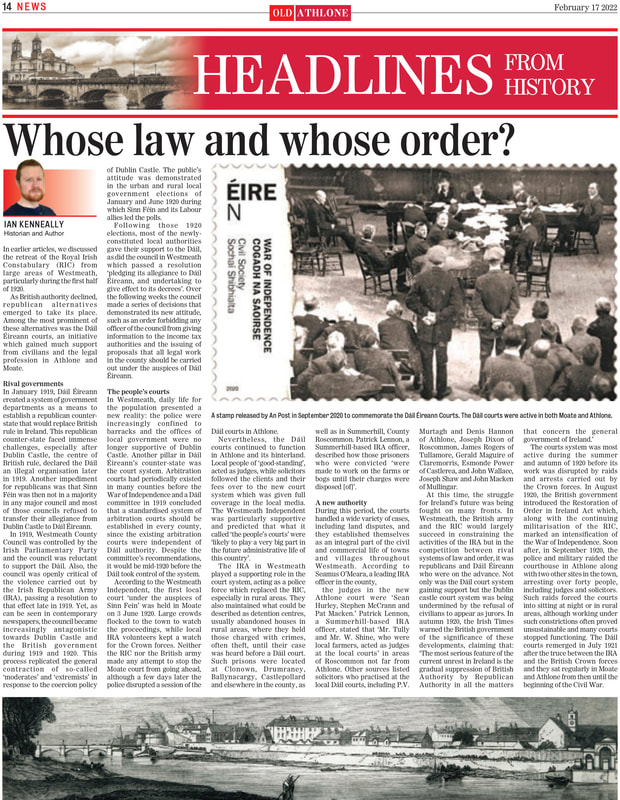
As British authority declined,
r e p u b l i c a n  a l t e r n a t i v e s
emerged to take its place.
Among the most prominent of
these alternatives was the Dáil
Éireann courts, an initiative
which gained much support
from civilians and the legal
profession in Athlone and
Moate.
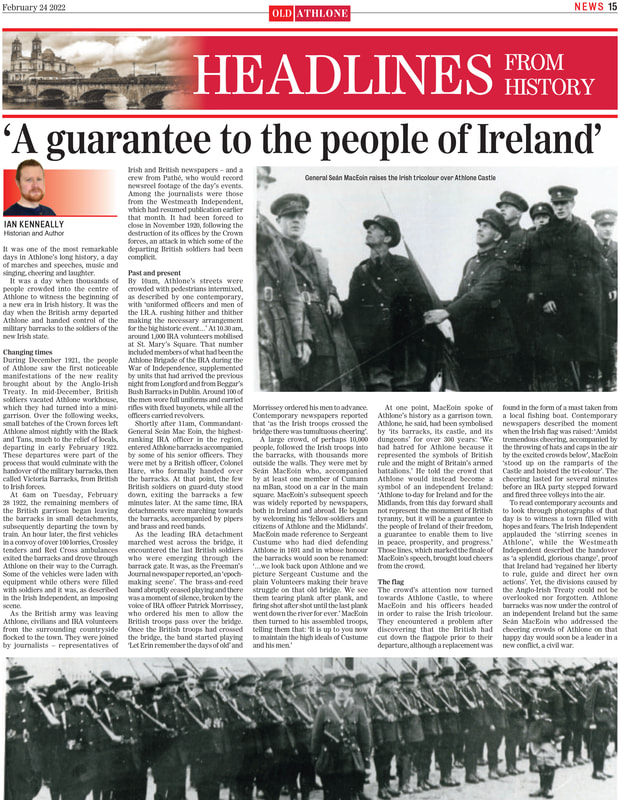
It was one of the most remarkable
days in Athlone’s long history, a day
of marches and speeches, music and
singing, cheering and laughter.
It was a day when thousands of
people crowded into the centre of
Athlone to witness the beginning of
a new era in Irish history. It was the
day when the British army departed
Athlone and handed control of the
military barracks to the soldiers of the
new Irish state
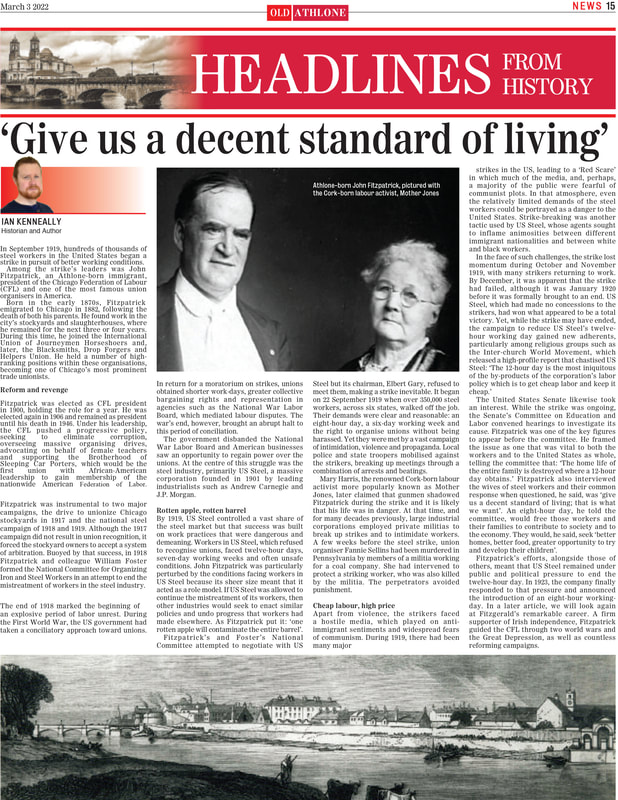
In September 1919, hundreds of thousands of steel workers in the United States began a
strike in pursuit of better working conditions.
Among the strike’s leaders was John
Fitzpatrick, an Athlone -born immigrant,
president of the Chicago Federation of Labour
(CFL) and one of the most famous union
organisers in America.
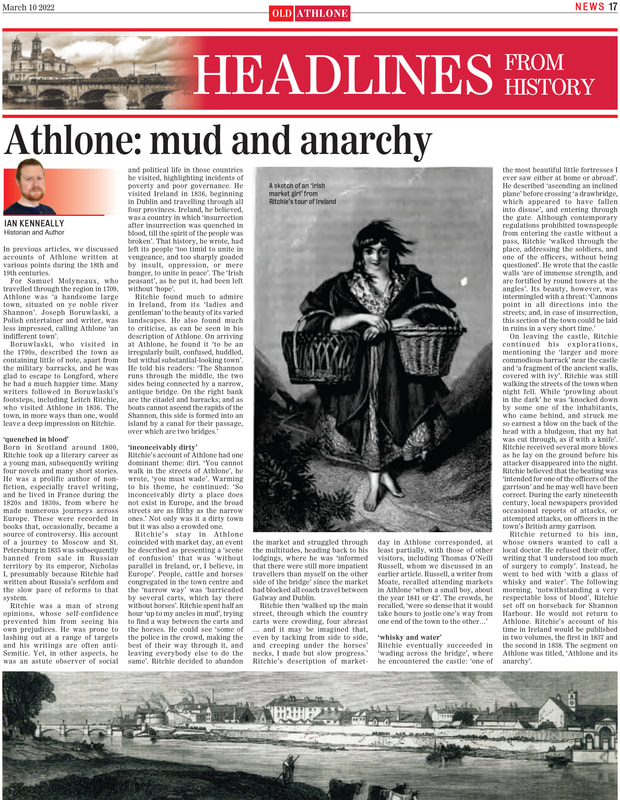
Leitch Ritchie visited Athlone in 1836. The
town, in more ways than one, would
leave a deep impression on Ritchie.
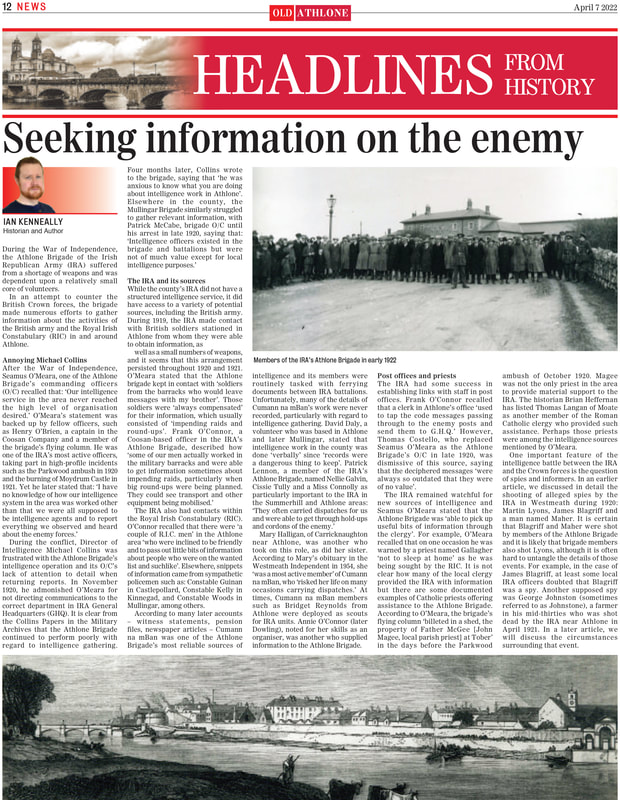
During the War of Independence,
the Athlone Brigade of the Irish
Republican Army (IRA) suffered
from a shortage of weapons and was
dependent upon a relatively small
core of volunteers.
In an attempt to counter the
British Crown forces, the brigade
made numerous efforts to gather
information about the activities of
the British army and the Royal Irish
Constabulary (RIC) in and around
Athlone.
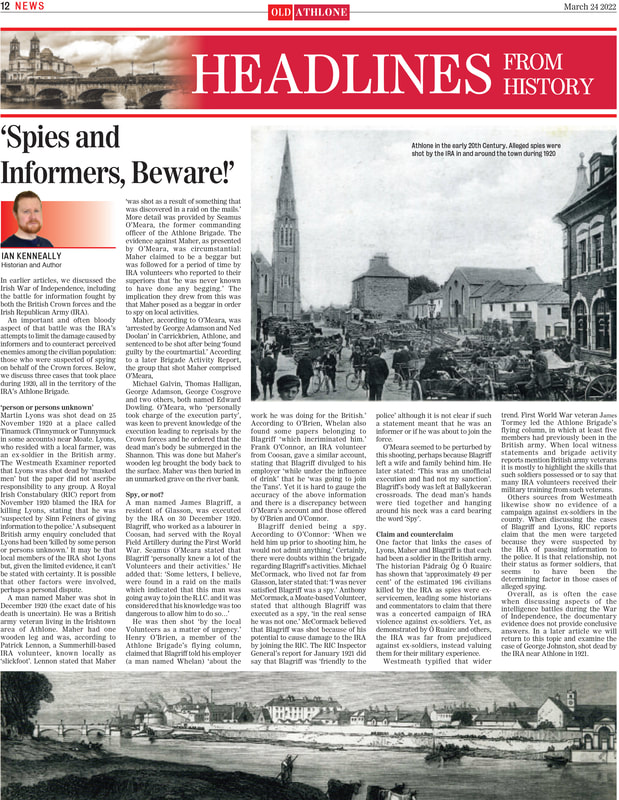
An important and often bloody
aspect of that battle was the IRA’s
attempts to limit the damage caused by
informers and to counteract perceived
enemies among the civilian population:
those who were suspected of spying
on behalf of the Crown forces. Below,
we discuss three cases that took place
during 1920, all in the territory of the
IRA’s Athlone Brigade.
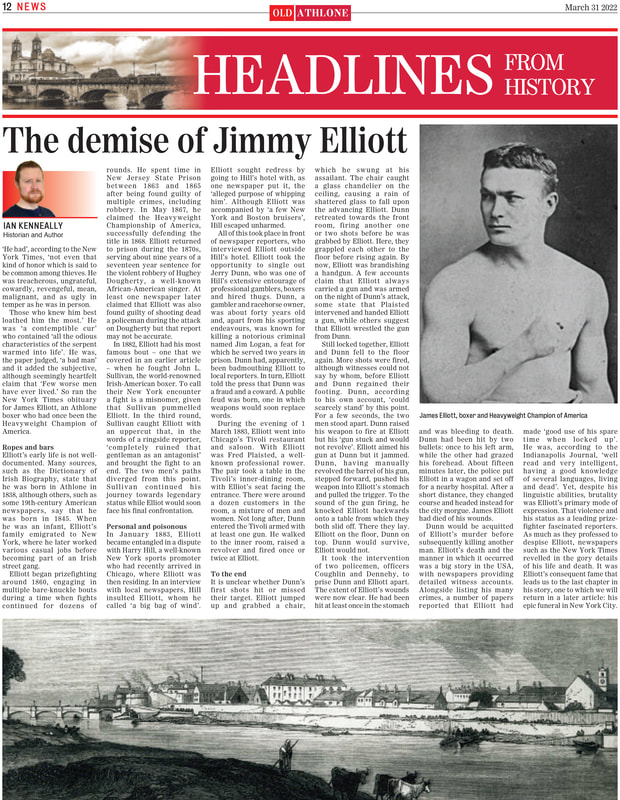
Those who knew him best
loathed him the most.’ He
was ‘a contemptible cur’
who contained ‘all the odious
characteristics of the serpent
warmed into life’. He was,
the paper judged, ‘a bad man’
and it added the subjective,
although seemingly heartfelt
claim that ‘Few worse men
have ever lived.’ So ran the
New York Times obituary
for James Elliott, an Athlone
boxer who had once been the
Heavyweight Champion of
America.
During the War of Independence,
the Athlone Brigade of the Irish
Republican Army (IRA) suffered
from a shortage of weapons and was
dependent upon a relatively small
core of volunteers.
In an attempt to counter the
British Crown forces, the brigade
made numerous efforts to gather
information about the activities of
the British army and the Royal Irish
Constabulary (RIC) in and around
Athlone.
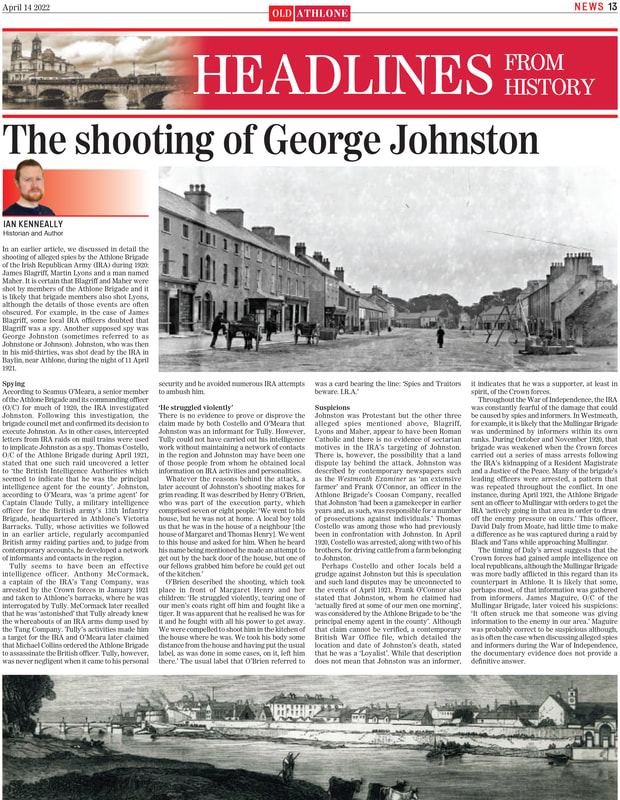
In an earlier article, we discussed in detail the
shooting of alleged spies by the Athlone Brigade of the Irish Republican Army (IRA) during 1920: James Blagriff, Martin Lyons and a man named
Maher. Another supposed spy was
George Johnston (sometimes referred to as Johnstone or Johnson). Johnston, who was then
in his mid-thirties, was shot dead by the IRA in Baylin, near Athlone, during the night of 11 April 1921.
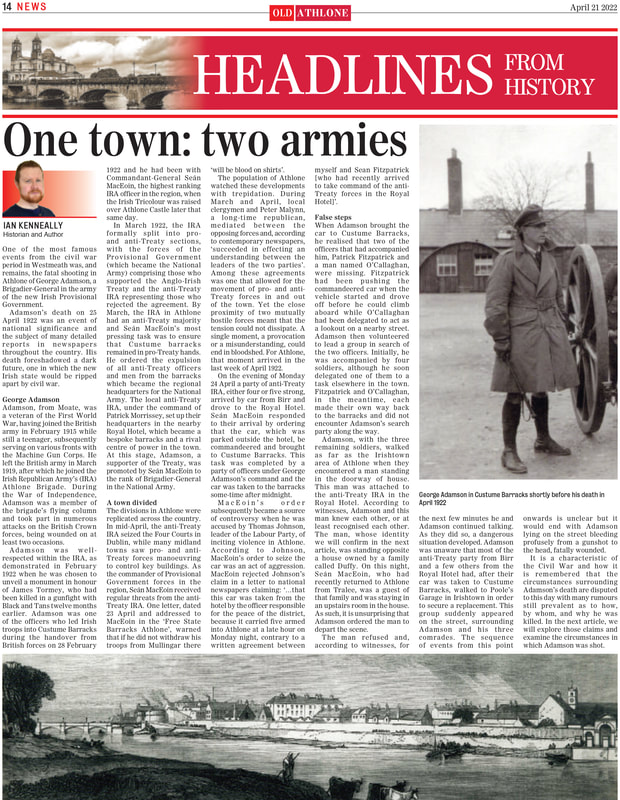
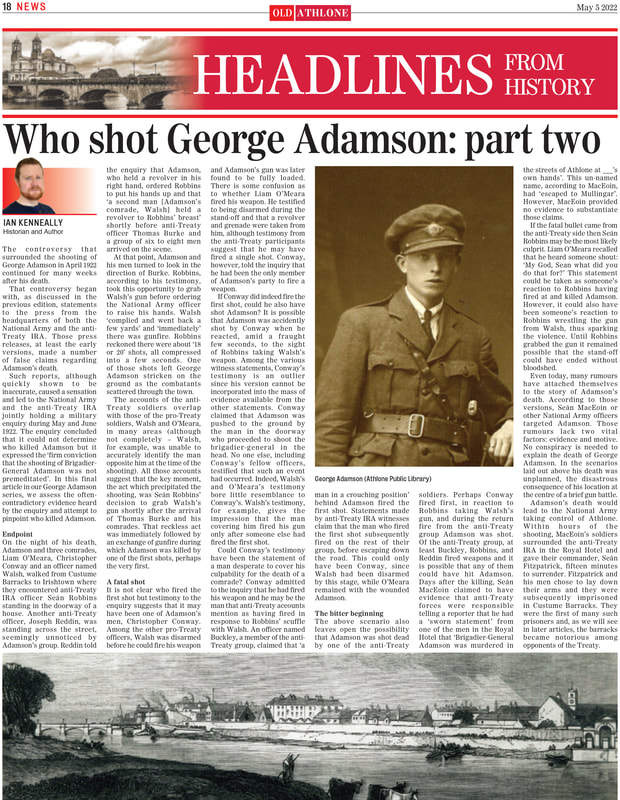
One of the most famous events from the civil war period in Westmeath was, and
remains, the fatal shooting in Athlone of George Adamson, a
Brigadier-General in the army of the new Irish Provisional Government.
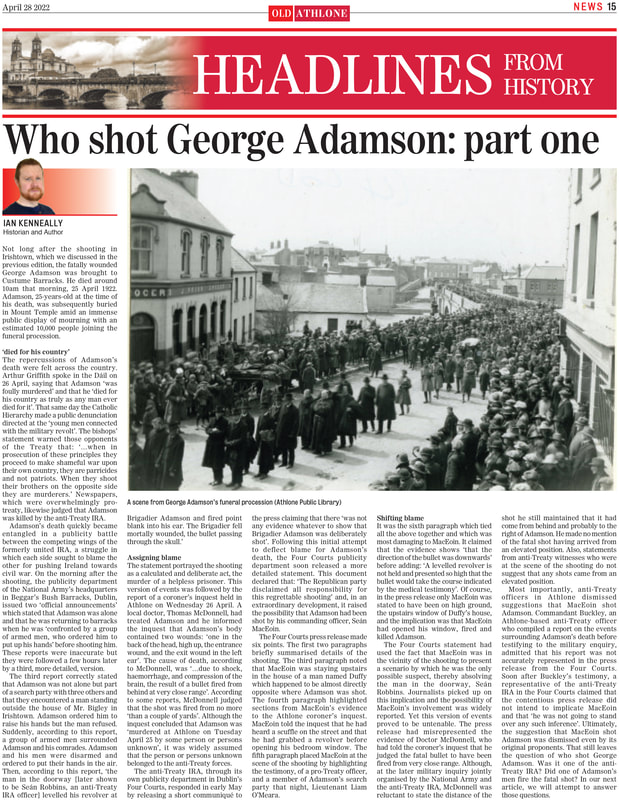
Not long after the shooting in Athlone, the fatally wounded
George Adamson was brought to Custume Barracks. He died around 10am that morning, 25 April 1922.
The controversy that
surrounded the shooting of George Adamson in April 1922
continued for many weeks after his death.
That controversy began with statements
to the press from the
headquarters of both the National Army and the anti-Treaty IRA.
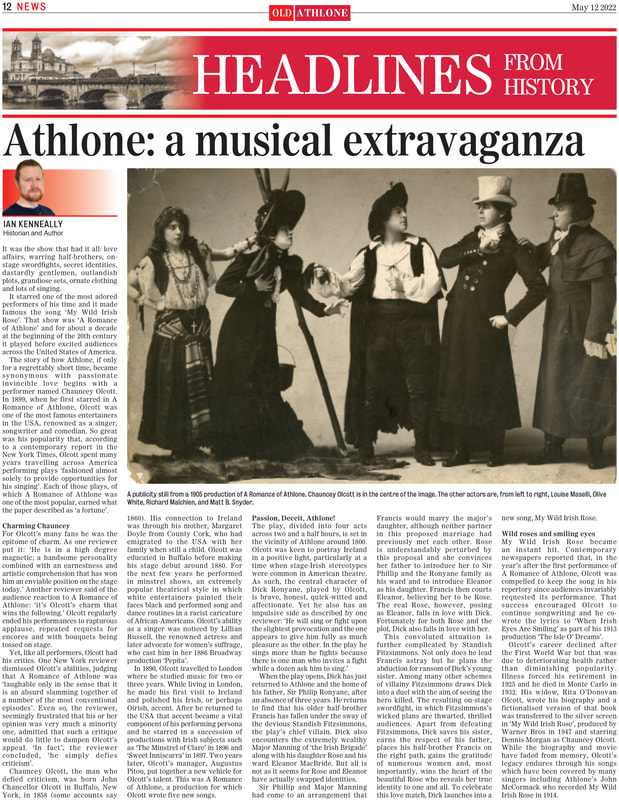
It was the show that had it all: love
affairs, warring half-brothers, onstage
sword fights, secret identities, dastardly gentlemen, outlandish
plots, grandiose sets, ornate clothing and lots of singing. It starred Chauncey Olcott, one of the most adored performers of his time, and it made
famous the song ‘My Wild Irish Rose’. That show was ‘A Romance
of Athlone’.
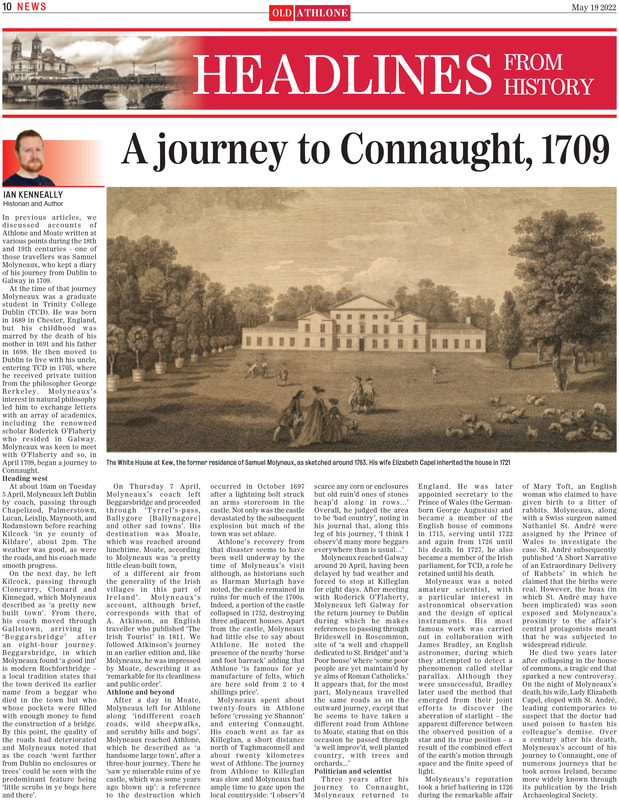
There are many accounts of Athlone and Moate written at various points during the 18th and 19th centuries. One such account was written by Samuel Molyneaux, who kept a diary of his journey from Dublin to Galway in 1709.
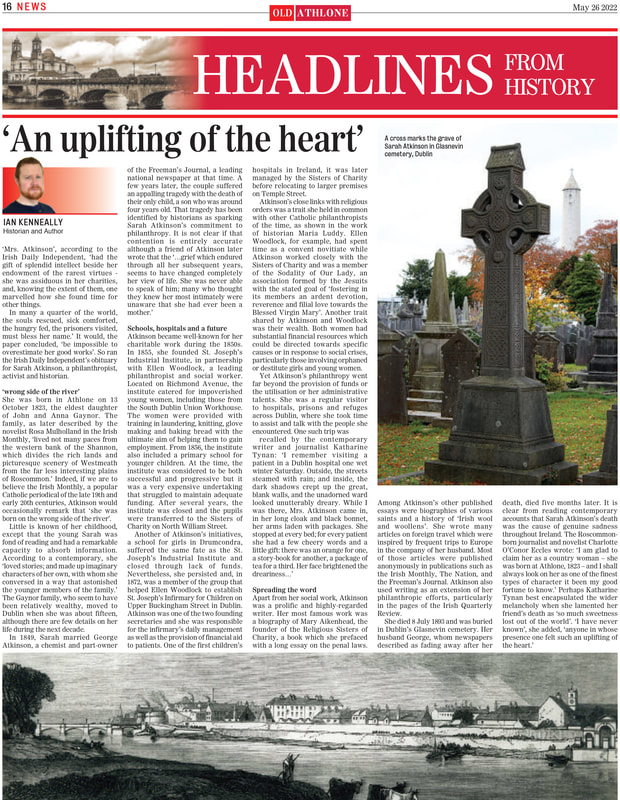
‘Mrs. Atkinson’, according to the Irish Daily Independent, ‘had the gift of splendid intellect beside her endowment of the rarest virtues... She was assiduous in her charities, and, knowing the extent of them, one marvelled how she found time for other things. In many a quarter of the world, the souls rescued, sick comforted, the hungry fed, the prisoners visited, must bless her name.’ It would, the paper concluded, ‘be impossible to overestimate her good works’. So ran the Irish Daily Independent’s obituary for Sarah Atkinson, a philanthropist, activist and historian.
In this edition, we trace the history of John Bruce, whose long military career included postings in India, China and Australia. Bruce was born in Athlone in July 1808. The Bruce family had, at least according to local tradition in Athlone, fled Scotland after the failed Jacobite Rising of the mid-1740s, later settling in the town.
In 1832, while in India, John Bruce married Johannah Jacoba Herklotz, daughter of a Dutch judge. In 1850, the couple, along with their children, moved to the Penal Colony of Western Australia. There, John Bruce took up a senior role with the newly-formed Pensioner Force, whose role was to guard the convicts who were then arriving in the colony. There he encountered John Boyle O'Reilly.
In this edition, we explore the role played by the Irish Republican Brotherhood (IRB) in and around Athlone during the War of Independence. This revolutionary organisation long pre-dated the Irish Republican Army (IRA), having been founded in 1858, although it was reorganised by Michael Collins, Harry Boland and others in the aftermath of the 1916 Rising.
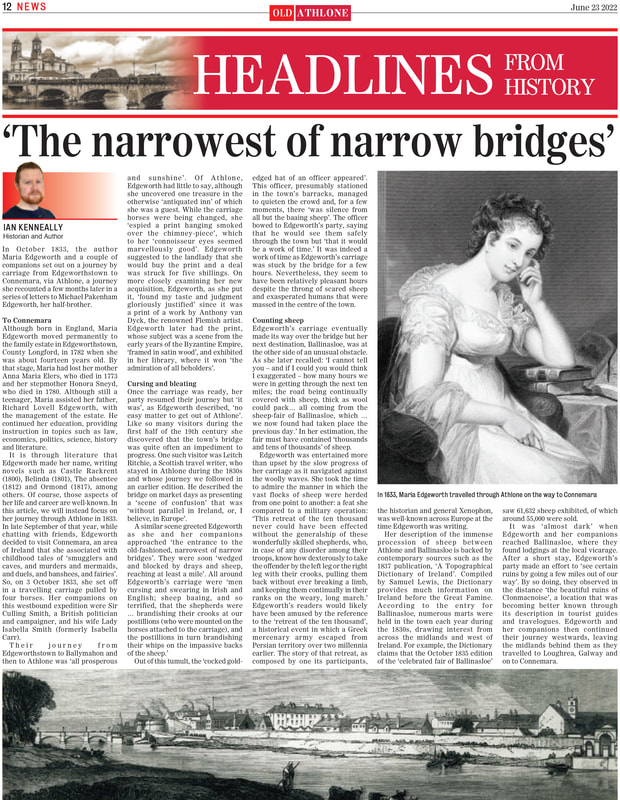
In October 1833, the author Maria Edgeworth and a couple of companions set out on a journey by carriage from Edgeworthstown to Connemara, via Athlone. It was a journey she recounted a few months later in a series of letters to Michael Pakenham Edgeworth, her half-brother.
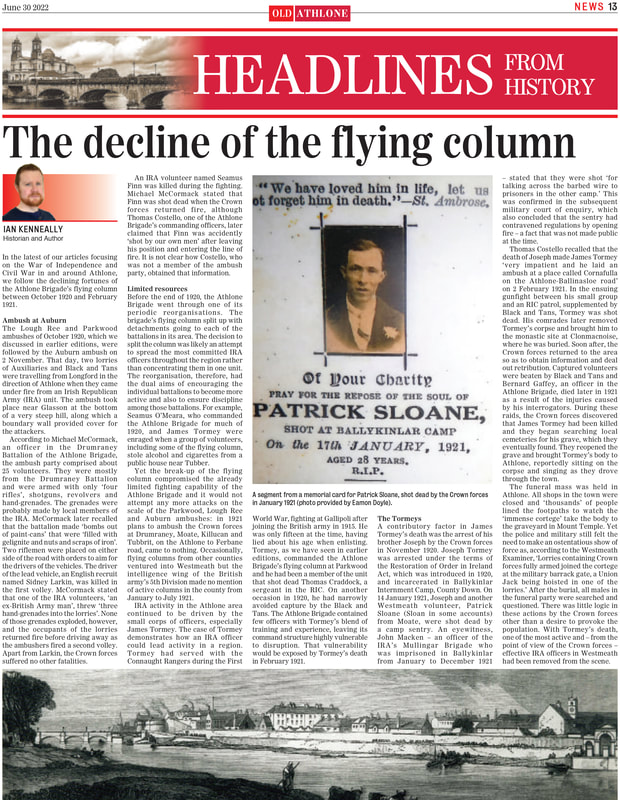
In the latest of our articles focusing on the War of Independence and Civil War in and around Athlone, we follow the declining fortunes of the Athlone Brigade’s flying column between October 1920 and February 1921.
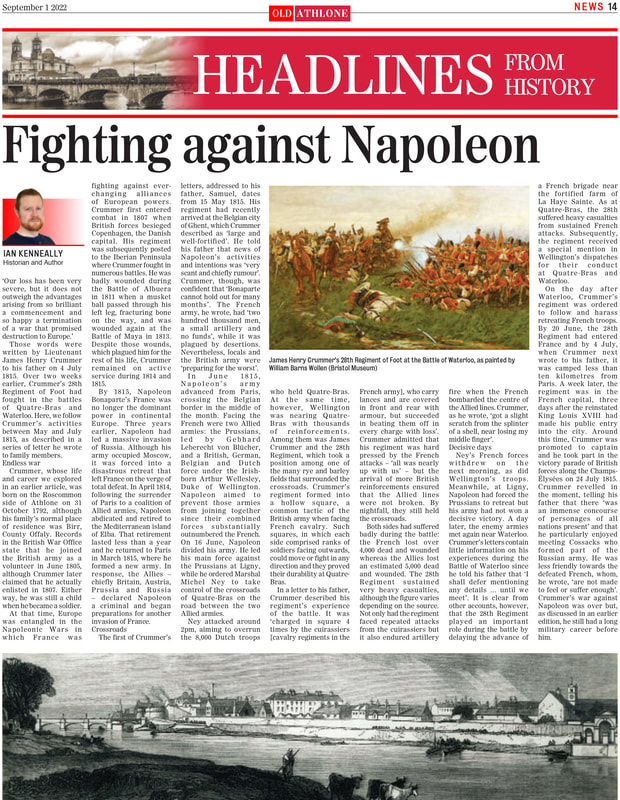
Athlone’s history has long been influenced by its military barracks and soldiers from the town have fought in conflicts around the world. Among those soldiers was James Henry Crummer. Little is known of Crummer’s early life, although some sources state that his parents were Samuel Crummer, whose normal place of residence was Birr, County Offaly, and Jane Sparke.
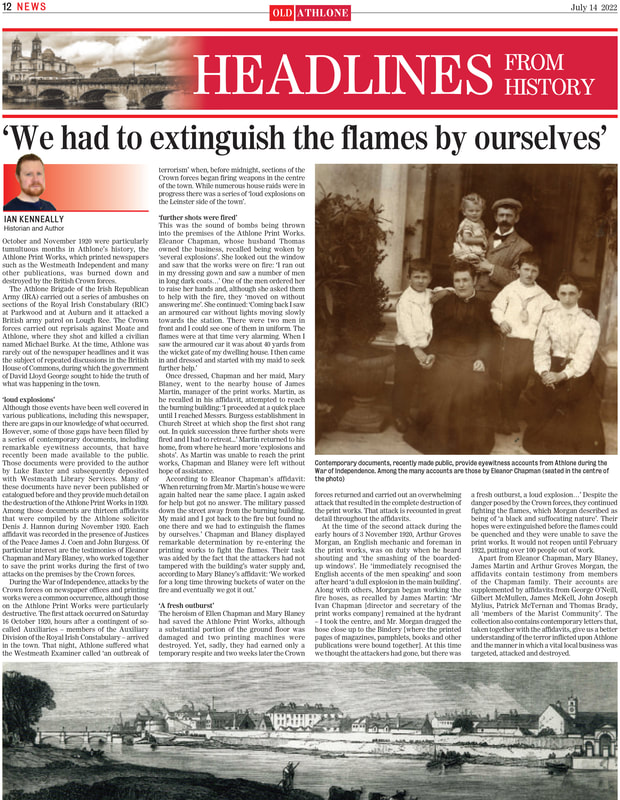
October and November 1920 were particularly tumultuous months in Athlone’s history. The Athlone Print Works, which printed newspapers such as the Westmeath Independent and many other publications, was burned down and destroyed by the British Crown forces.
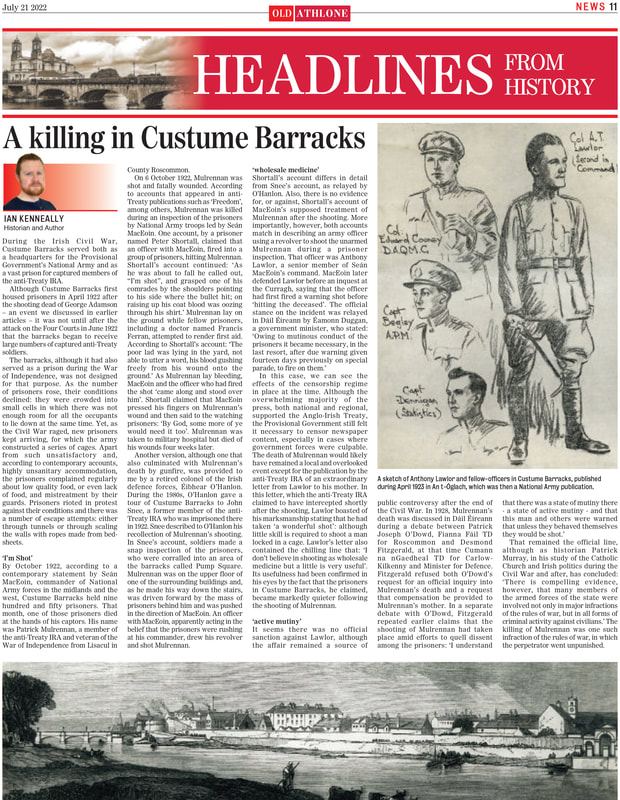
By October 1922, according to a contemporary statement by Seán MacEoin, commander of National Army forces in the midlands and the west, Custume Barracks held nine hundred and fifty prisoners. That month, one of those prisoners died at the hands of his captors. His name was Patrick Mulrennan, a member of the anti-Treaty IRA and veteran of the War of Independence from Lisacul in County Roscommon.
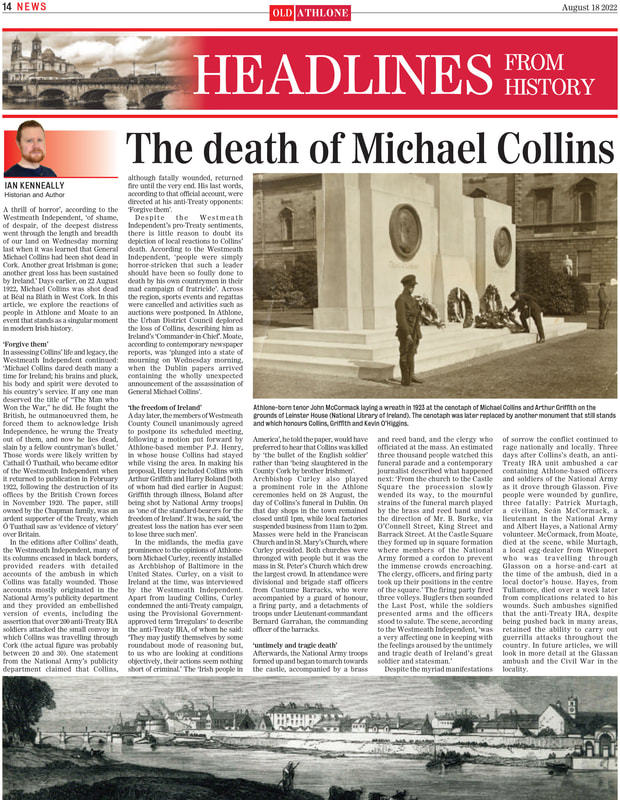
‘A thrill of horror’, according to the Westmeath Independent, ‘of shame, of despair, of the deepest distress went through the length and breadth of our land on Wednesday morning last when it was learned that General Michael Collins had been shot dead in Cork. Another great Irishman is gone; another great loss has been sustained by Ireland.’ Days earlier, on 22 August 1922, Michael Collins was shot dead at Béal na Bláth in West Cork. In this article, we explore the reactions of people in Athlone and Moate to an event that stands as a singular moment in modern Irish history.
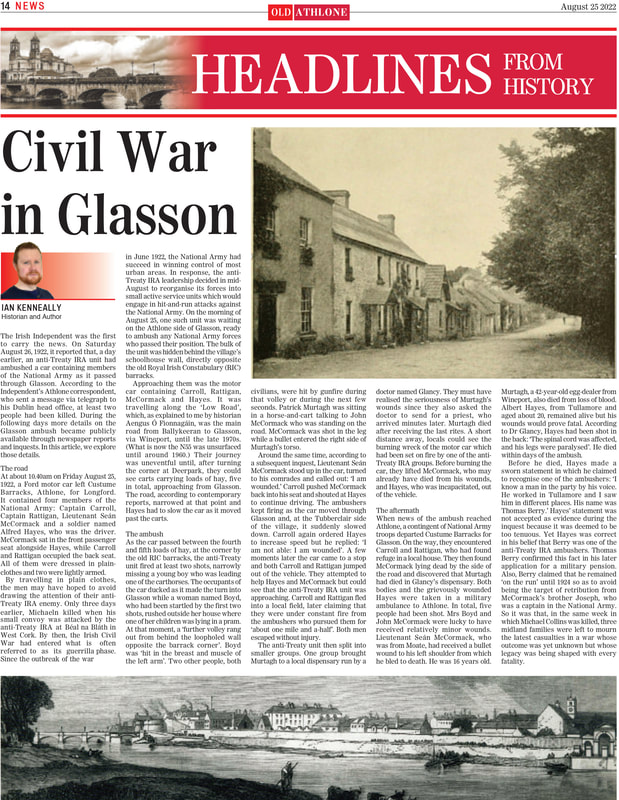
The Irish Independent was the first to carry the news. On Saturday 26 August 1922, it reported that, a day earlier, an anti-Treaty IRA unit had ambushed a car containing members of the National Army as it passed through Glasson. According to the Independent’s Athlone correspondent, who sent a message via telegraph to his Dublin head office, at least two people had been killed. During the following days more details on the Glasson ambush became publicly available through newspaper reports and inquests. In this article, we explore those details.
‘Our loss has been very severe, but it does not outweigh the advantages arising from so brilliant a commencement and so happy a termination of a war that promised destruction to Europe.’ Those words were written by Lieutenant James Henry Crummer to his father on 4 July 1815. Over two weeks earlier, Crummer’s 28th Regiment of Foot had fought in the battles of Quatre-Bras and Waterloo. Here, we follow Crummer’s activities between May and July 1815, as described in a series of letter he wrote to family members.
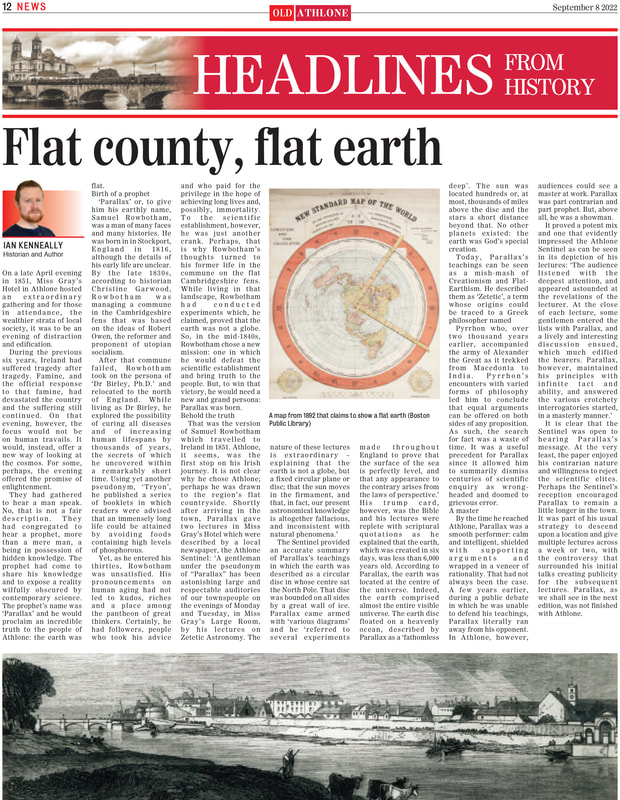
On a late April evening in 1851, Miss Gray’s Hotel in Athlone hosted an extraordinary gathering. For those in attendance, the wealthier strata of local society, it was to be an evening of distraction and edification. During the previous six years, Ireland had suffered tragedy after tragedy. Famine, and the official response to that famine, had devastated the country and the suffering still continued. On that evening, however, the focus would not be on human travails. It would, instead, offer a new way of looking at the cosmos. For some, perhaps, the evening offered the promise of enlightenment.

They had gathered to hear a man speak. No, that is not a fair description. They had congregated to hear a prophet, more than a mere man, a being in possession of hidden knowledge. The prophet had come to share his knowledge and to expose a reality wilfully obscured by contemporary science. The prophet’s name was ‘Parallax’ and he would proclaim an incredible truth to the people of Athlone: the earth was flat.
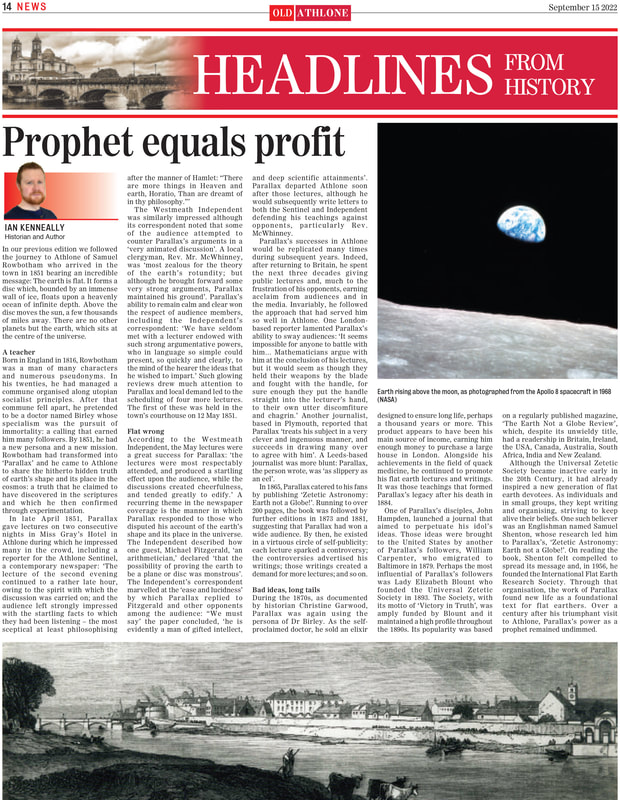
In our previous edition we followed the journey to Athlone of Samuel Rowbotham. He arrived in the town in 1851 bearing an incredible message: The earth is flat. It forms a disc which, bounded by an immense wall of ice, floats upon a heavenly ocean of infinite depth. Above the disc moves the sun, a few thousands of miles away. There are no other planets but the earth, which sits at the centre of the universe.
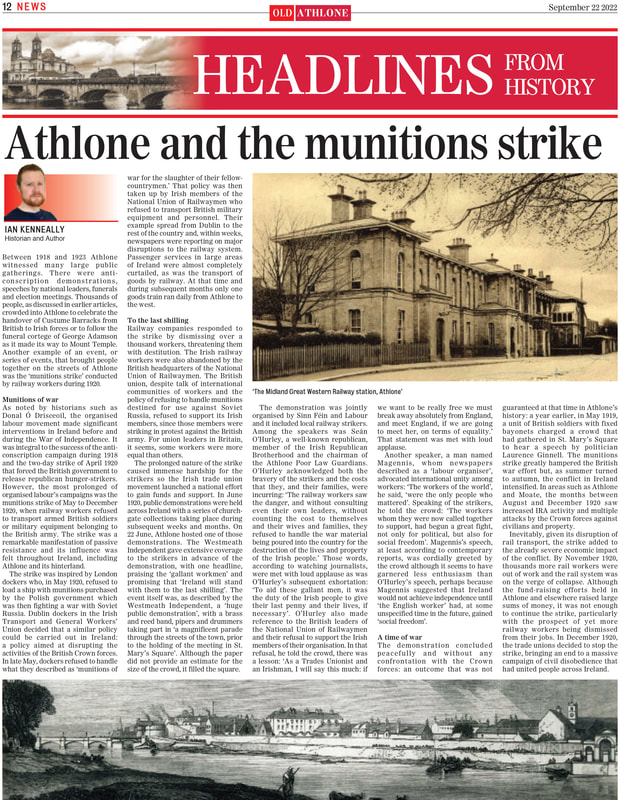
Between 1918 and 1923 Athlone witnessed many large public gatherings. There were anti-conscription demonstrations, speeches by national leaders, funerals and election meetings. Thousands of people, as discussed in earlier articles, crowded into Athlone to celebrate the handover of Custume Barracks from British to Irish forces or to follow the funeral cortege of George Adamson as it made its way to Mount Temple. Another example of an event, or series of events, that brought people together on the streets of Athlone was the ‘munitions strike’ conducted by railway workers during 1920.
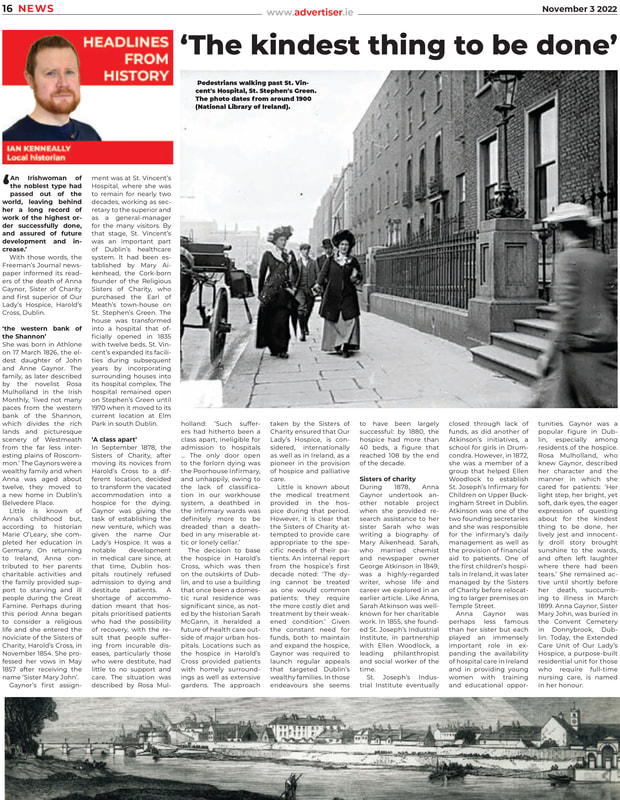
‘An Irishwoman of the noblest type had passed out of the world, leaving behind her a long record of work of the highest order successfully done, and assured of future development and increase.’ With those words, the Freeman’s Journal newspaper informed its readers of the death of Anna Gaynor, Sister of Charity and first superior of Our Lady's Hospice, Harold's Cross, Dublin. She was born in Athlone on 17 March 1826, the eldest daughter of John and Anne Gaynor. The family, as later described by the novelist Rosa Mulholland in the Irish Monthly, ‘lived not many paces from the western bank of the Shannon, which divides the rich lands and picturesque scenery of Westmeath from the far less interesting plains of Roscommon.’

Click on the pictures to see the articles
Copyright, Ian Kenneally - See also johnboyleoreilly.com and revolutionpapers.com
  • Home
  • Books
    • From the Earth, A Cry
    • AIT: a history
    • The Paper Wall
    • Courage & Conflict >
      • John Barry
      • The San Patricios
      • The Irish Battalion of the Papal Army
      • Irish Soldiers of the American Civil War
      • John Philip Holland
      • The Irish who fought at the Little Bighorn
      • John Henry Patterson
      • Mutiny in the Connaught Rangers
      • Dublin's Bloody Sunday
    • The Irish Regional Press, 1892–2018
  • Research and Consultancy
    • The History Show
    • 19 Crimes
    • 1921 Expedition to Mount Everest
    • Historian in Residence: 2020, 2021 and 2022
    • The Revolution Papers
    • AIT: a history
    • Gorey: a portrait of a town and its hinterland
  • Headlines from History
  • Exhibitions
    • 1921 Expedition to Mount Everest
    • 'Shall the punishment fall on the girl alone'
  • Documentaries
  • Other Projects
    • Atlas of the Irish Revolution
    • The Irish-American Press
    • Irish Journalism before Independence
    • Independent Newspapers: A History
    • War of Independence in the Midlands
    • Periodicals and Journalism in 20th Century Ireland
    • Irish Civil War in the Midlands
  • Gallery
  • Contact